The Evolution of Tokenization
Tokens have consistently demonstrated the highest adoption rate among blockchain use cases, serving as the primary driver of network effects and capital formation in the cryptocurrency ecosystem. The progression of token launches has followed a clear evolutionary path:- Bitcoin (2009) established the viability of digital scarcity through proof-of-work consensus
- Ethereum ICOs (2014-2015) introduced programmable token launches, enabling anyone to bootstrap a decentralized network
- The 2017 ICO Wave demonstrated both the massive capital formation potential and the systemic risks of unregulated token launches
- friend.tech (2023) pioneered community-launched social tokens with dynamic pricing mechanisms
- pump.fun (2024) scaled the bonding curve launchpad model to mainstream adoption
Token Layer Infrastructure
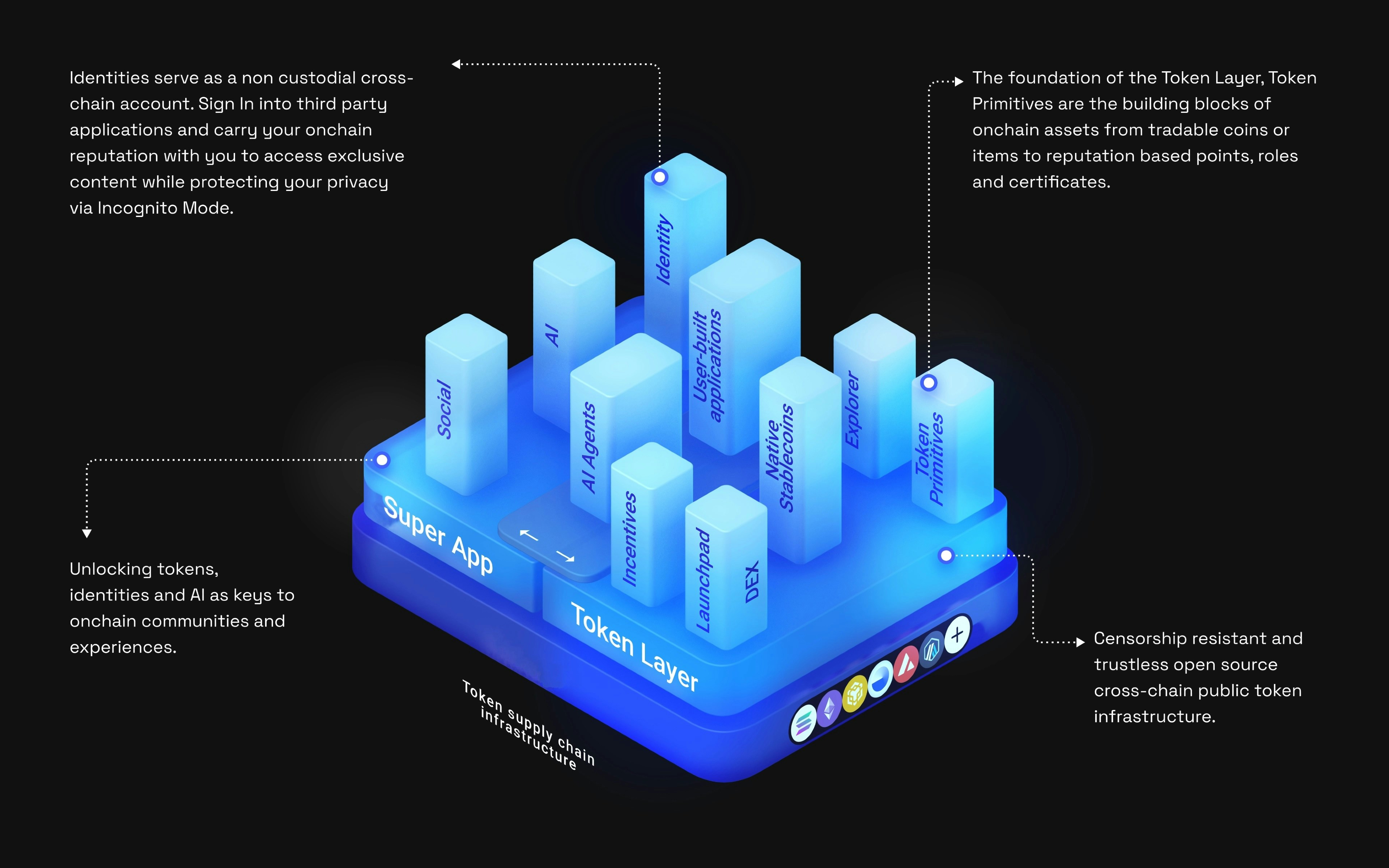
- Standardized token deployment across EVM and SVM (Solana) chains
- Automated liquidity provision on graduation to external DEXes (Uniswap, PancakeSwap, Meteora)
- Real-time onchain incentive distribution denominated in stablecoins
- Cross-chain interoperability without centralized custodians via LayerZero
- Permissionless integration through REST API, SDKs, and Model Context Protocol
Launch Tokens
Configurable bonding curves and parameters
Token Primitives
Coins, IP Certificates, Roles, Hubs, and more
Earn Incentives
Protocol referrals, token referrals, creator rewards
Supported Networks
EVM and Solana chains
Stablecoin-First Design
The Problem with Volatile Quote Assets
Traditional token launches pair new tokens against volatile native assets (ETH, SOL, BNB), which introduces compounded volatility risk, cognitive complexity, and adoption friction. Users must track exchange rates across multiple volatile pairs to understand true value.Why Stablecoins
USD-denominated stablecoins have emerged as the most traded quote assets globally. Token Layer implements stablecoin-first trading pairs across all supported chains, establishing USD as the default unit of account. Benefits:- Eliminates quote asset volatility from trading pairs
- Universal pricing reference across exchanges and chains
- Simplified valuation in familiar denominated units
- Reduced capital inefficiency for liquidity providers
The Incentives Layer
The Token Incentive Problem
Traditional web3 incentive mechanisms followed a predictable failure pattern: projects distributed native tokens as rewards, users immediately sold them, sustained selling pressure depressed token prices, and project economics became unsustainable before achieving product-market fit. This model failed because participants had no rational incentive to hold low-liquidity, high-volatility reward tokens long-term.Token Layer’s Approach
Token Layer implements a stablecoin-denominated incentive layer with real-time distribution onchain without centralized custodians. All rewards are paid in USD stablecoins, eliminating hold risk and creating sustainable growth mechanisms across four pillars: Protocol Referrals, Token Referrals, Creator Rewards, and Builder Codes. This creates sustainable revenue streams for users, creators, and developers without requiring grants or token launches. See Earn with Token Layer for detailed implementation.Unified Token Standard
The Multi-Chain Fragmentation Problem
Existing token standards create significant user experience challenges: the same conceptual token exists under different contract addresses on each chain, liquidity is siloed across chains, and implementation variance introduces subtle incompatibilities.The DeF1 Standard
Token Layer implements a unified token standard where:- All EVM-compatible chains use identical contract addresses for the same token
- Solana implementations maintain address consistency through deterministic derivation
- All tokens implement identical methods across chains
- The DeF1 suffix (Decentralized Finance) provides instant protocol recognition
Cross-Chain Architecture
The Cost of Chain Proliferation
The blockchain ecosystem has witnessed significant capital allocation toward launching new Layer 1 and Layer 2 networks, duplicating infrastructure development and fragmenting network effects. Token Layer takes an alternative approach: leveraging existing chains with established user bases, security properties, developer ecosystems, and network effects. This allows projects to capture existing capital and mindshare rather than bootstrap new networks from zero.Infrastructure Economics
Historically, implementing production-grade cross-chain token functionality required dedicated engineering teams, security audits for each chain, and ongoing maintenance infrastructure—representing approximately $200,000+ annually in engineering costs. Token Layer abstracts this complexity through protocol-level cross-chain support powered by LayerZero, providing permissionless cross-chain messaging without centralized operators. All Token Layer functionality works uniformly across supported chains, and new chains can be added through governance. See Supported Networks for all integrated chains.Scalability and Extensibility
Token Layer is architected for long-term scalability across multiple dimensions: Primitive Extensibility: New token types can be added through governance without protocol-wide upgrades. Feature Composability: Modular components enable innovation at the application layer without core protocol changes. Network Expansion: New blockchains can be added through standardized integration processes. User Scale: Infrastructure handles increasing transaction volumes through efficient data structures, layered caching, and horizontal scalability.Initial Token Deployment
To bootstrap protocol adoption and demonstrate cross-chain capabilities, Token Layer is launching a memecoin for each supported blockchain network. This initial deployment:- Establishes trading activity and liquidity across all supported chains
- Validates referral mechanisms and fee distribution
- Creates chain-specific communities for feedback and governance
- Demonstrates protocol functionality in production conditions
Get Started
Token Layer is live and accessible to all participants:Launch Tokens
Deploy tokens across multiple chains
Trade
Trade tokens on supported networks
Earn
Monetize through referrals and builder codes
API Reference
Integrate programmatically
Summary
Token Layer addresses the core challenges of modern token infrastructure:- Stablecoin-first trading and incentives for price stability and sustainable growth
- Cross-chain by default through LayerZero integration and unified token standards
- Permissionless innovation via comprehensive API, SDK, and MCP access
- Scalable architecture designed for primitive extensibility and network expansion